
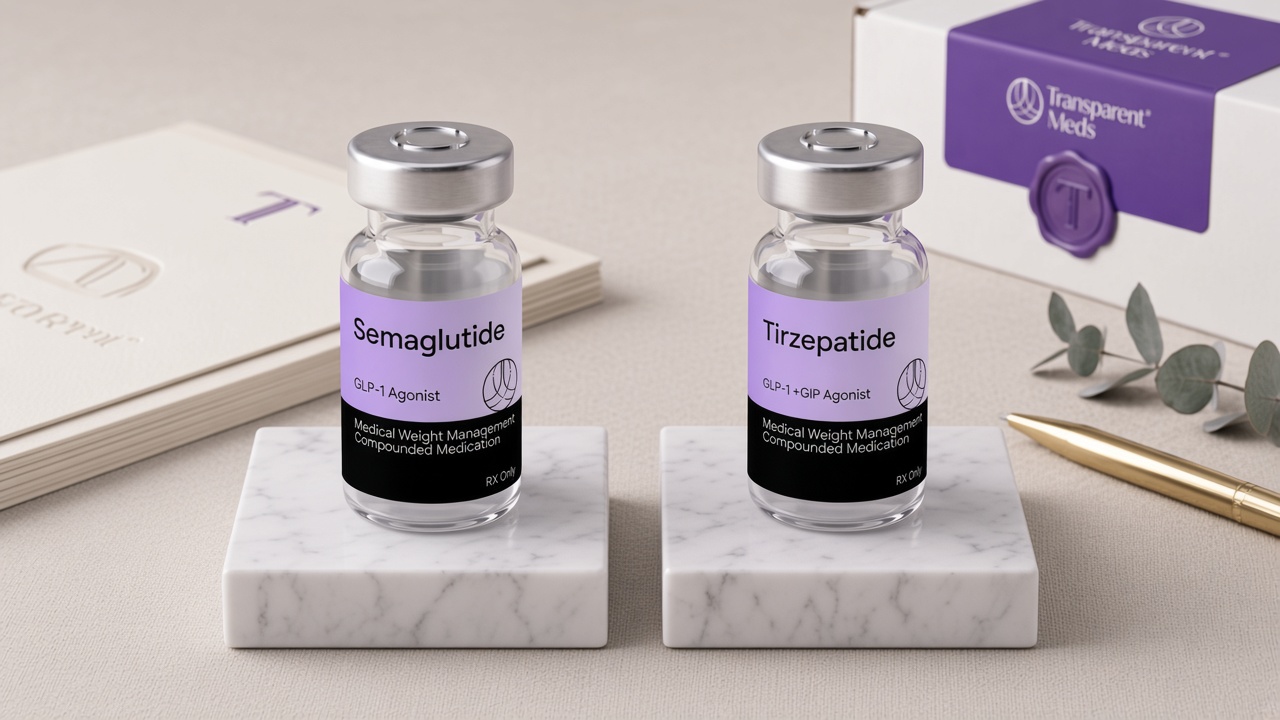
Semaglutide and tirzepatide are often discussed together, but they are not interchangeable. They use different active ingredients and act on different hormone pathways. Your health history, response, side effects, and budget can all shape which option a licensed provider considers.
The short version: compounded semaglutide costs $99 per month through Transparent Meds, and compounded tirzepatide costs $199 per month. Price matters, but it is only one part of the decision. This comparison explains what else to discuss before you choose.
For the broader context, start with the complete GLP-1 weight loss guide. You can also browse the Learn hub and the weight loss article collection.
How do semaglutide and tirzepatide work differently?
Semaglutide acts on a signaling pathway called GLP-1. GLP-1 is a hormone your body naturally releases after eating. It is involved in fullness, digestion, and blood sugar signaling. Medication that acts on this pathway may help you feel satisfied sooner or remain full longer.
Tirzepatide acts on GLP-1 and a second pathway called GIP. GIP is another hormone involved in the body's response to food. Acting on two pathways does not automatically make tirzepatide the right choice for every person. It simply means the medication works differently.
Both options are usually injected under the skin on a regular schedule. A provider starts with a lower dose and may increase it gradually. You should follow the instructions for the specific concentration and product you receive.
Is tirzepatide better than semaglutide?
There is no universal “better” option. Research averages can help clinicians understand a medication, but they cannot tell you exactly how your body will respond. One person may do well with compounded semaglutide while another may have a more workable experience with compounded tirzepatide.
A useful comparison looks at several questions. Are appetite changes helping you follow a balanced eating pattern? Are side effects manageable? Can you stay hydrated and eat enough protein? Is the monthly cost realistic? Does the schedule fit your routine? Your provider should consider the complete picture rather than chasing the highest dose or a single number on a scale.
If you want to understand when changes may become noticeable, read the GLP-1 timeline guide.
What side effects can each option cause?
Both can cause digestive symptoms. Nausea, constipation, diarrhea, stomach discomfort, burping, and a strong feeling of fullness are commonly discussed. Headache and fatigue can also occur. Your experience may change after a dose increase.
The practical response is similar for either option: eat smaller meals, slow down, drink fluids steadily, and tell your care team when symptoms are persistent or worsening. Very rich meals and large portions may feel more uncomfortable because digestion can be slower.
Severe abdominal pain, repeated vomiting, an inability to keep fluids down, or symptoms of a serious allergic reaction require prompt medical attention. Do not assume a difficult symptom is simply proof that the medication is working. The GLP-1 side-effect guide explains what you can track and when to escalate.
How do the dosing schedules compare?
Both medications are commonly given as a weekly subcutaneous injection, but the dose amounts are not equivalent. Milligrams of semaglutide cannot be converted directly into milligrams of tirzepatide. Compounded products may also come in different concentrations, so syringe units are not a universal dose.
A provider may keep you at a lower dose, move you up gradually, pause an increase, or change the plan based on response and tolerability. Higher is not automatically better. Moving up too quickly may make digestive symptoms harder to manage.
Never use an online chart to adjust your own prescription. Read the pharmacy label, confirm the concentration, and ask the care team to explain both milligrams and syringe units. If you switch products, request fresh written instructions rather than relying on your prior syringe markings.
How much do the two programs cost?
Transparent Meds lists compounded semaglutide at $99 per month and compounded tirzepatide at $199 per month. Those are cash-pay program prices. When comparing any online program, check whether the advertised amount includes medication, provider review, shipping, supplies, and follow-up support.
Also ask whether the price changes by dose. Some providers advertise an entry price that rises during titration. Check for separate membership fees, required lab costs, long commitments, and cancellation rules. The relevant number is the complete recurring cost, not a large “was” price next to a smaller promotional figure.
Our GLP-1 cost without insurance guide gives you a practical comparison checklist.
Who might discuss semaglutide with a provider?
Cost can make compounded semaglutide a reasonable option to discuss when both medications could otherwise fit. A provider may also consider your previous medication experience, current prescriptions, medical history, and comfort with potential side effects.
Do not choose based only on a friend's experience. Tell your provider about digestive conditions, gallbladder history, kidney concerns, pregnancy or breastfeeding, upcoming procedures, allergies, and any relevant personal or family endocrine history. Include vitamins, supplements, and nonprescription products.
The provider may decide that medication is not appropriate, request more information, or recommend a different plan. That is part of a real clinical review, not an obstacle to get around.
Who might discuss tirzepatide with a provider?
Compounded tirzepatide may be considered when its dual-pathway action and your individual history make it a reasonable option to evaluate. Some people also discuss it after an unsatisfactory experience with another approach. A switch still requires careful instructions because doses are not interchangeable.
The higher $199 monthly price should fit your budget beyond the first month. Starting a program that you cannot reasonably continue can create stress and interrupted care. Ask what happens if you need to pause, whether support remains available between visits, and how refills are handled.
No website can determine candidacy from a marketing headline. A licensed provider should review the same health details that matter for compounded semaglutide and explain why a particular option is being considered.
What should you know about compounded options?
Transparent Meds offers compounded semaglutide and compounded tirzepatide. These medications are compounded by a state-licensed 503A pharmacy. They are not FDA-approved. Prescription required.
A compounded medication is prepared for an individual prescription by a compounding pharmacy. It is not a generic product reviewed in the same way as a brand-name medication. Ask for the dispensing pharmacy, active ingredient, concentration, storage requirements, beyond-use date, and instructions for questions or damaged shipments.
Do not accept vague claims that a compounded product is “the same” as a brand. Formulation, concentration, delivery method, and instructions may differ. You should be able to identify exactly what you received and how your prescribed milligram dose maps to the marked syringe.
What questions should you ask before deciding?
Ask your provider why one option fits your history, what symptoms to report, how dose decisions are made, and what follow-up is included. Ask the program whether monthly pricing changes and whether you can contact a clinician between scheduled visits.
Then check the practical details: Which pharmacy dispenses it? What arrives in the package? How should it be stored? What should you do after a missed dose? Who handles a delayed or warm shipment? Clear answers matter more than a long list of marketing claims.
You can review Transparent Meds weight loss options and current pricing when you are ready to consider an evaluation. Your provider makes the prescribing decision after reviewing your information.
How should you think about switching medications?
A switch is a new prescribing decision, not a simple dose conversion. Tell your provider why you are considering it: side effects, cost, availability, an unclear response, or another concern. Include the exact dose, concentration, date of your last injection, and any gaps in use.
Do not finish one vial and begin the other using a schedule found online. Semaglutide and tirzepatide doses are not equivalent, and the provider may choose a different starting point or timing based on your history.
Before the first dose after a switch, review the new label line by line. Confirm the active ingredient, concentration, milligrams, syringe units, injection day, storage directions, and follow-up date. Dispose of unused medication only as the pharmacy directs, and do not combine leftovers.
Prescription required.
Frequently asked questions
What is the main difference between semaglutide and tirzepatide?
Semaglutide acts on the GLP-1 pathway. Tirzepatide acts on GLP-1 and GIP pathways. That difference can affect appetite, digestion, dosing, and individual response.
Which option costs less through Transparent Meds?
The compounded semaglutide program is $99 per month, while the compounded tirzepatide program is $199 per month. Review current inclusions before enrolling.
Can you switch from one option to the other?
A licensed provider may consider a switch after reviewing your response, side effects, dose, and health history. You should not calculate or make a switch on your own.
Are compounded semaglutide and compounded tirzepatide FDA-approved?
No. Compounded medications are not FDA-approved, and the FDA does not review them for safety, effectiveness, or quality before use.
Do both options require a prescription?
Yes. A licensed provider must determine whether either medication is appropriate for you.
Keep learning

Transparent care
Talk to a licensed provider
See whether the weight loss program may fit your goals, then review pricing before you decide. Prescription required.
View program details