
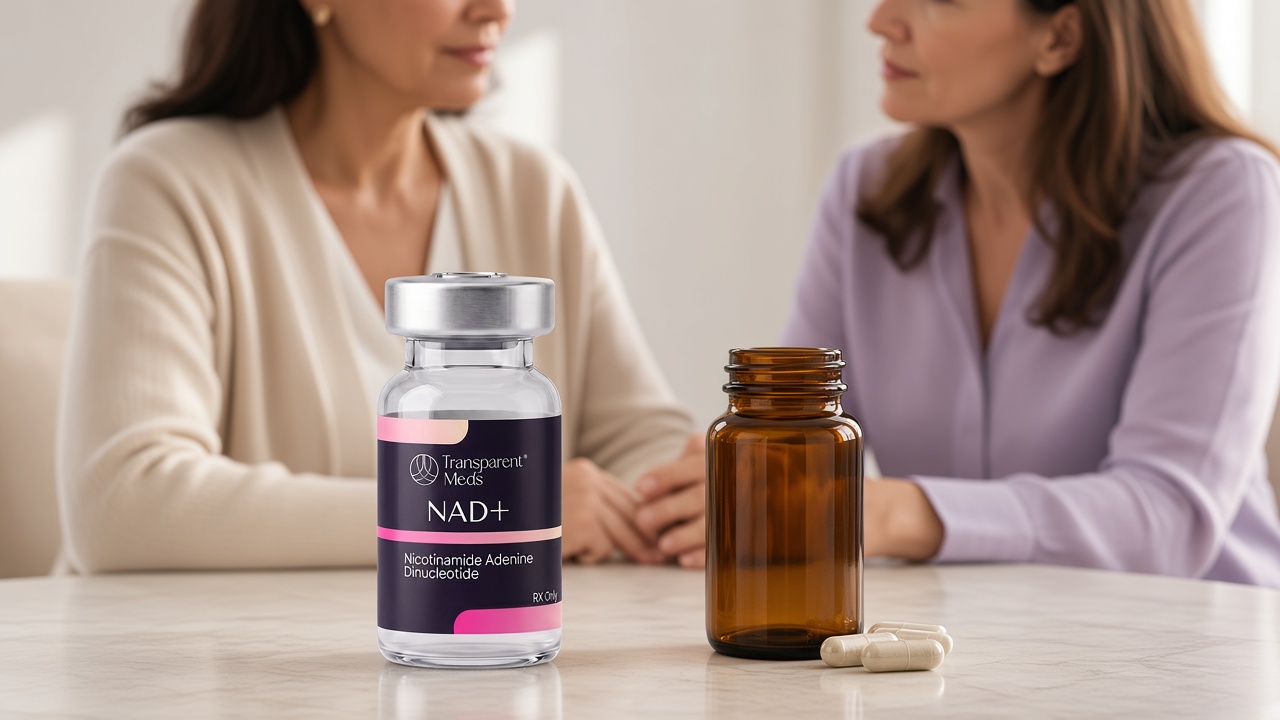
Walk into a supplement aisle and you will find NAD+ capsules, powders, sublingual tablets, and patches. Search online and you will find injections and IV drips. Same three letters, very different products, very different prices.
This page compares the injection format with the oral options honestly, including where the injection has a real advantage and where the claim outruns the evidence. Transparent Meds offers injections only, so read this as a comparison written by someone with a stake in one answer. The broader picture lives in the NAD+ injections guide, and more background sits in the healthy aging section and the Learn hub.
What is the actual difference between an injection and a capsule?
The difference is route of administration, and it changes what happens to the molecule before it reaches your bloodstream.
A capsule goes through your stomach and small intestine. Digestive enzymes and gut bacteria act on it, and whatever survives passes through the liver first, where a good portion is broken down before it ever reaches general circulation. This is called first-pass metabolism.
A subcutaneous injection places the solution into the fatty layer under your skin. It absorbs from that tissue into the bloodstream gradually, skipping the gut and the first pass through the liver entirely.
So yes, more of an injected dose reaches circulation intact. That is not a marketing claim, it is basic pharmacology. The harder question is what that extra availability buys you.
Does oral NAD+ even survive digestion?
Most oral products do not contain NAD+ itself, and there is a reason for that. NAD+ is a relatively large, charged, unstable molecule. It tends to be broken down in the gut into smaller pieces before absorption.
That is why the supplement market is built on precursors instead. Nicotinamide riboside and nicotinamide mononucleotide are smaller, more stable molecules that your cells can convert into NAD+ through the salvage pathway. If you want the chemistry between those two, see NAD+ vs NMN.
Human trials of oral precursors have shown they can raise NAD+ markers in blood at typical supplement doses. That part is reasonably well replicated. What is inconsistent is the next step: whether the people taking them report or demonstrate meaningful changes in energy, strength, or aging-related measures. Several well-run trials have found raised blood markers alongside unchanged outcomes.
If a capsule brand cites a study, check which part it is citing. "Raises NAD+ levels" and "improved how participants functioned" are very different findings.
Is the injection more effective, then?
Higher bioavailability is a mechanism, not an outcome. Direct head-to-head trials comparing subcutaneous NAD+ injections against oral precursors, in people, measuring things people care about, are essentially absent.
What that means practically: nobody can honestly tell you the injection outperforms a capsule for fatigue, focus, or healthy aging, because the study that would answer it has not been done at a scale worth quoting. Anyone who states it flatly is filling a gap with confidence.
What can be said is narrower and still useful. An injection delivers a known quantity into your system without depending on gut health, stomach acid, or a product's disintegration profile. Supplement quality varies widely, and third-party testing has repeatedly found capsules that do not contain what the label claims. A prescription product compounded by a state-licensed 503A pharmacy has a documented formulation and a named pharmacy behind it. Compounded medications are not FDA-approved, which means the FDA has not reviewed them for safety, effectiveness, or quality. Prescription required.
Consistency of what you are actually taking is a legitimate reason to prefer a prescription route. It is a different argument from "it works better," and it deserves to be made separately.
What does each option cost?
This is where the comparison gets concrete.
| Format | Typical cost | Where it happens |
|---|---|---|
| Oral NR or NMN capsules | $30 to $90 per month | Anywhere |
| Subcutaneous NAD+ injection | $149 per month at Transparent Meds | At home, after instruction |
| NAD+ IV infusion | $250 to $800 per session | Clinic visit |
Capsules are cheaper per month, full stop. If budget is the deciding factor and you want to try the category at all, that is the entry point, with the caveat that you are buying a supplement with variable quality control.
The injection sits in the middle on price and higher on consistency and clinical oversight. The IV sits highest on cost and time, and that comparison is worked out in NAD+ injection vs IV.
What about convenience and daily routine?
Capsules win on friction. You swallow them with breakfast and forget about it. No needles, no refrigeration, no sharps container, no learning curve.
Injections require more of you. You store the vial as directed, draw the prescribed amount, use a new sterile needle each time, rotate sites, and dispose of needles safely. Most people find the mechanics straightforward after the first few, but "straightforward" is not the same as "effortless," and some people simply do not want to inject themselves. That is a valid reason to choose differently.
Frequency also differs. Capsules are usually daily. Injection schedules are set by prescription and are typically less frequent, which some people prefer. The injection frequency and protocol depends entirely on what your provider wrote for you, not on a schedule you found in a forum.
What about sublingual, nasal, or patch versions?
The market has expanded well past capsules, and the newer formats are usually sold on the same absorption argument: skip the gut, get more into you.
Sublingual tablets and sprays are designed to absorb through the tissue under your tongue. The idea is reasonable in principle, since some molecules do cross there efficiently. Whether NAD+ specifically does so at a meaningful rate is not well established in published human data, and the absorption figures in product marketing rarely cite a source you can check.
Nasal sprays and transdermal patches face similar questions. Both routes work well for certain drugs and poorly for others, and molecule size and charge largely determine which. NAD+ is not an obviously favorable candidate on either count.
Transparent Meds does not offer these formats, so there is no product here to recommend against. The point is methodological: a novel delivery route is a claim that needs evidence, not an upgrade you can assume. Ask what testing exists for that specific product, and read confident absorption percentages without a citation as marketing.
Which one should you choose?
There is no universal answer, but there are honest tiebreakers.
An oral precursor may make sense if you are curious, cost-sensitive, and comfortable with supplement-grade quality control. Buy from a brand that publishes third-party testing, and set a date to reassess.
An injection may make sense if you want a prescription product with a named pharmacy and documented concentration, you want provider involvement, and you are comfortable with self-administration. It may also make sense if you have tried oral products and want a route that does not depend on digestion.
Neither option is a substitute for working up a real problem. Persistent fatigue has a long list of causes worth ruling out first, including thyroid issues, anemia, sleep apnea, depression, and medication effects. Start with what NAD+ is if you are still getting oriented, and bring the question to a provider who is willing to tell you when the answer is not NAD+ at all.
Whatever you choose, decide in advance what you are measuring and how long you will give it. Prescription required.
Frequently asked questions
Is an NAD+ injection better absorbed than a capsule?
An injection skips digestion and first-pass liver metabolism, so more of the dose reaches circulation intact. Better absorption is a pharmacology point, not proof of a better outcome for a specific goal.
Do oral NAD+ supplements do anything at all?
Human trials of oral precursors such as NR and NMN have raised measurable NAD+ markers in blood. Whether that translates into how you feel has been less consistent across studies.
Why do most supplement brands sell precursors instead of NAD+ itself?
NAD+ is a large, unstable molecule that does not survive digestion well. Precursors are smaller and more stable, which is why NR and NMN dominate the capsule market.
Can you take an oral supplement and an injection together?
Tell your provider about every supplement you take before adding a prescription product. Stacking is a clinical decision, and combining products makes it harder to know what caused any change.
Does Transparent Meds sell oral NAD+?
No. Transparent Meds offers NAD+ as an injection only, at $149 per month. Oral and IV formats are covered here for comparison, not because we sell them.
Keep learning
Transparent care
Talk to a licensed provider
See whether the healthy aging program may fit your goals, then review pricing before you decide. Prescription required.
View program details